| |
|
 |
|
Artist Painting
Thangka |
| |
|
 |
|
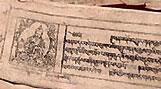
Tibetan Manuscript |
|
|
Painting
Besides
archaeological excavations, two other areas that reveal
a lot about Nepalese culture, both past and present, are
painting and sculpture. Fortunately, there are many fine
and well-preserved articles that have survived the
passage of time and thus enabled detailed research to be
made. Looking briefly at the history of Nepalese
painting, it appears that ancient icon and religious
paintings entered the valley during the Lichchhavi
period. Lichchhavi inscriptions dating from the
mid-fifth century AD inform us that traders, monks and
Brahmans, as well as artists from neighboring areas
visited the Katmandu Valley from time to time.
Katmandu Valley, located on the crossroads of the major
trade routes from India to Tibet was the place of
consequentially becomes the cultural center for the
exchange of icons and paintings.
The Chinese envoy, Wang Hsuan Tse, who came to Nepal in
the 7th century AD, described quite eloquently the
houses in the valley which even at that time were
embellished with sculptures and paintings. Although
there are no surviving examples of paintings form
Lichchhavi period (400-750AD), it can be surmised that
the murals or wall-paintings noticed by the Chinese
envoy, were probably like those that adorn monasteries,
temples, and houses today. Since the sculpture tradition
of Nepal during the early centuries of the Christian era
was so vital and creative, there seems no reason to
believe that the tradition of painting was not equally
sophisticated.
Ancient Paintings
The earliest examples of Nepalese painting are in the
form of manuscript illustrations on palm leaves. When
the first surviving paintings are examined, it becomes
quite clear that they are the result of along and
well-developed pictorial tradition. The antiquity of
Nepalese manuscripts goes back to the ninth century;
however, not all early manuscripts were illustrated. The
earliest known example o an illustrated manuscript is
the Astasahasrika Prajnaparamita dated 1015AD. These
manuscripts invariably consist of narrow folios of palm
leaves about thirty centimeters long, depending on text,
but not wider than five centimeters. The manuscripts are
perforated in two places, loosely held together with
string and protected by wooden covers on both sides.
These wooden covers, a large number of which have
fortunately survived, are more lavishly painted than the
manuscripts themselves. In palm leaf manuscript, the
scribe leaves spaces for illustrations, which the
artists' later paint with figures of divinities.
Influence
of religion on Paintings
All surviving illustrated manuscripts, whether Buddhist
or Hindu, are illustrated with heretic images of gods
and goddesses. A large number of manuscripts are devoted
to the principal events from the life of Buddha or the
hieratic images of gods and goddesses. A large number of
manuscripts are devoted to the principal events from the
life of Buddha or the hieratic representations of
Vajrayana deities, which bear little relation to the
text. During the early medieval period, Prajnaparamita,
the personification of wisdom, became one of the most
popular deities in Nepal. Manuscripts consecrate to this
deity were repeatedly copied. Besides these Buddhist
manuscripts, illuminated manuscripts of Hindu divinities
such as Brahma, Vishnu, Shiva, Karttikeya and Ganesh
were also frequently represented.
Manuscripts continued to be painted and copied for
centuries, for the act of donating a manuscript to a
monk, priest, monastery or temple was considered by both
Hindus and Buddhists to be an act of great virtue. Early
illustrated manuscripts were executed in the same basic
style but later examples, particularly paper manuscripts
were executed in the same basic style but later
examples, particularly paper manuscripts, clearly show
signs of deterioration in quality.
Thangka Paintings
Religious
Paintings worshipped, as icons are known as paubha in
Newari and thangka in Tibetan. The origin of paubha or
thankga paintings may be attributed to the Nepalese
artists responsible for creating a number of special
metal works and wall paintings as well as illuminated
manuscripts in Tibet.
Realizing the great demand for religious icons in Tibet,
these artists, along with monks and traders, took with
them from Nepal not only metal sculptures but also a
number of Buddhist manuscripts. To better fulfill the
ever-increasing demand, Nepalese artists initiated a new
type of religious painting on cloth that could be easily
rolled up and carried along with them. This type of
painting became very popular both in Nepal and Tibet and
so a new school of thangka painting evolved as early as
the ninth or tenth century and has remained popular to
this day. One of the earliest specimens of Nepalese
thangka painting dates from the 13th /14th century and
shows Amitabha surrounded by Bodhisattava. Another
Nepalese thangka with three dates in the inscription
(the last one corresponding to 1369AD), is one of the
earliest known as thangkas with inscriptions. The "Mandala
of Vishnu" dated 1420 AD, is another fine example of the
painting of this period. Early Nepalese thangkas are
simple in design and composition. The main deity, a
large figure, occupies the central position while
surrounded by smaller figures of lesser divinities.
Influence
of Tantrism on Paintings
From the 15th century onwards, brighter colors gradually
began to appear on Nepalese thangka. Because of the
growing importance of the Tantric cult, various aspects
of Shiva and Shakti were painted in conventional poses.
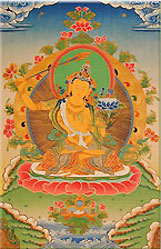
Mahakala, Manjushri, Lokeshwara and other deities were
equally popular and so were also frequently represented
in thangka paintings of later dates. As Tantrism
embodies the ideas of esoteric power, magic forces, and
a great variety of symbols, strong emphasis is laid on
the female element and sexuality in the paintings of
that period.
Back to Top |
| |
 |
|
Newari Mandala |
| |
 |
|
Manjushri |
|


