| |
|
 |
|
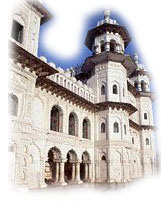
Janaki Mandir,
Janakpur |
| |
|
 |
|
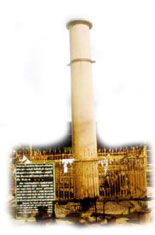
Ashoka Pillar,Lumbini |
|
Archaelogy
Over the past
few decades, much archaeological work has been conducted
in the Terai region of the country where Nepal's first
settlements were probably located. Tilaurakot for
example, used to be the capital of Shakya dynasty and is
situated in Kapilvastu district in western Nepal. The
Present archaeological site extends over an area of more
than five kilometers. The central portion, measuring
approx. five thousand meters by four thousand meters, is
surrounded by the citadels of three periods. The first
and second are made of muddating from 600 to 200B.C.
while the third wall appears to have constructed with
kiln-burnt bricks and was probably build around 150 BC.
The eastern gate, the eastern stupa, the Ashita Apsidal
Stupa and the defense wall were discovered at the site.
Recent excavation brought to light the majestic western
gateway complexes including the watchman's room, six
meters broad roads of different periods (with card-track
impressions), the moat on the east and west, three
periods of defense walls and the northern twin stupas
with sixteen and seven meter diameters, made and
enlarged between the fourth and second centuries B.C.
The central portion of the site has also been excavated
and various brick structures belonging to the third
century BC to the second century AD have been unearthed.
Water storage tanks, big jars, brick and terra-cotta
ring wells and a fire-altar have also been found. Other
antiquities discovered at the site are human and animal
terra-cotta figurines (dated 400 B.C. to 200 AD), silver
punch-marked coins, early cast coins with symbols,
Kushan coins, and pieces of Sunga and Kushan pottery.
Apart from these antiquities practical items such as
terra-cotta cart wheels, gamesmen's figures iron
implements, nails, arrow-heads, bone and copper rods,
dice and fishing hooks have also been found.
Nepal's other important
archaeological sites are:
Gotihawa-These
ancient ruins are situated nearly eleven kilometers
south of Taulihawa, the present district headquarters.
To the north of the Gotihawa village, there is an
ancient brick stupa and an Ashokan monolithic column.
The lower portion with its square granite base stone is
still intact but the crowning features and inscriptional
portions are mission. The site can be safely identified
as the Nirvan stupa of Kakuchhanda Buddha (one of the
previous Buddhas), whose hometown lies within one
kilometer of this stupa-pillar complex.
Back to Top
Sagarahawa-This
site is located nearly two km north of Tilaurakot on the
bank of the Banganga river. It was excavated in 1896 and
seventeen miniature stupas were found there. In the same
general region, sites of ancient civilization have been
identified at Lumbini, Banjarhi, Nipaniya and Kadyatawa
to mention just a few names. Several eastern region of
the country, the most important which are Bhediari,
Varahakshetra, Janakpur and Simarangarh.
Back to Top
Bhediari-Located
nearly ten km south of Biratnagar, the ancient ruins a
this site have revealed many important brick temples,
one of which has been fully excavated. It appears to
have been built in the Sunga period and shows two phases
of construction. There is a two-meter high rectangular
platform supported from the inside by cross walls. So
far no image either of stone or terra-cotta has been
found during the excavations; however, a number of
silver punch-marked coins have been found.
Back to Top
Varahakshetra-This is another important
temple site located at the confluence of the Koka and
Koshi rivers. The site is known to belong to the period
of later Guptas who had issued a copper grant for the
two Varaha images found there. Apart from these images,
there are many miniature Gupta period temple replicas,
which suggest that during the sixth to the seventh
centuries AD, many such temples, and idols were made.
Back to Top
Narasingha Tappa-Some years ago, while
cultivating lands at Narasingha Tappa, close to the
present town of Ithari, an idol of Vishnu was
discovered. The image belongs to the fifth or sixth
century AD and is based on the Gupta art school
tradition. It has now been temporarily kept inside a
local Shiva Temple. The site, according to local people
also contains pottery items, indicating that it was
inhabited as early as the Gupta dynasty (4th - 5th
centuries AD)
Back to Top
Janakpur-At
Rama-Janaki temple complex near Janakpur there is an
important image depicting Uma lying over a bed and
feeding a baby. Ganesh and Kumar are also depicted in
the panel while on the top of the scene is a Shiva
Lingam. The piece dates from the 12th or 13th century AD
and belongs to the Karnatakas of Simarangarh. Some
auspicious Symbols on the piece prove that it influenced
the Malla art period of Katmandu.
Back to Top
Simarangarh-This was the old capital city
of the Karnatakas of Mithila and was built by King
Nanyadeva in 1097-98AD. The ruins of the city extend
over the area of 16km, the whole area still being
surrounded by high kiln-burnt bricks. There are more
than one hundred images and sculptures scattered all
over the area. Most are made of black cist stone and are
nicely polished; however, a few are also made of
sandstone. The images represented at the site are of
Vishnu, Narayan, Lakshmi-Narayan, Shankarsana,
Garudopari Vishnu, Uma-Maheshwara, Durga, Shiva and
Surya (both types standing and holding lotus flowers,
while leaning over a seven-horsed chariot). In different
parts of Simarangarh, there are remains of temples and
gateways of the old city.
Other sites bearing Karnataka images and sculptures are
Kanchanpur (near Rajbiraj), Murtiya (west of Janakpur)
and Valmiky Nagar (near the Gandaki Barrage), as well as
several other places between the Gandaki and Saptakoshi
rivers.
Back to Top |
|
Nepal's Archaelogical Sites: |
|


