| |
|
|
|
 |
|
|
|
|
|
|
|
|
|
 |
|
Red
Machchhendranath |
|
|
|
|
|
|
|
|
 |
|
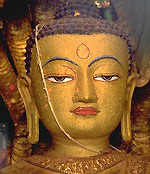
Statue of Buddha |
|
|
|
|
|
|
|
|
 |
|
|
|
Dancers, Mani
Rimdu |
|
|
|
|
|
|
|
|
|
|
|
|
|
|
|
|
|
|
|
|
|
|
|
|
|
|
|
|
|
|
|
|
|
|
|
|
|
|
|
|
|
|
|
|
|
|
|
|
 |
|
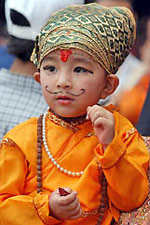
Dressed for Gaijatra |
|
|
|
|
|
|
|
|
|
|
|
|
|
|
|
|
|
|
|
|
|
|
|
|
|
|
|
|
|
|
 |
|
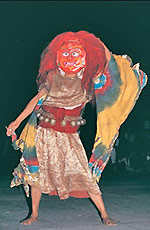
Lakhe Dance |
|
|
|
|
|
|
|
|
|
|
|
|
|
|
|
|
|
|
|
|
|
|
|
|
|
|
|
|
|
|
|
|
|
|
|
|
|
|
|
|
|
|
|
|
|
|
|
|
|
|
|
|
|
|
|
|
|
|
|
|
|
|
|
|
|
|
|
|
|
|
|
|
|
|
|
|
|
|
|
|
|
|
|
|
|
|
|
|
|
|
|
|
|
|
|
|
|
|
|
|
|
|
|
|
|
|
|
|
|
|
|
|
|
|
|
|
|
|
 |
|
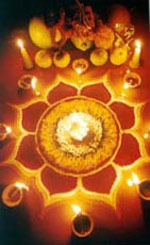
Lights at Tihar |
|
|
|
|
|
|
|
|
|
|
|
|
|
|
|
|
|
|
|
|
|
|
|
|
|
|
|
|
|
|
|
|
|
|
|
|
|
|
|
|
 |
|
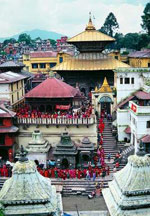
Pashupatinath
Temple |
|
|
|
|
|
|
Festivals
:
April - May/Baisakh
Navavarsha (New
Year's Day)
The Nepalese follow their own calendar system known as
the Bikram Era or Bikram Sambat. This festival
celebrates the first day of the first month of the New
Year and is observed as an official holiday. In
Bhaktapur, fifteen kilometers from Katmandu, the new
year celebrations take on added importance as the
"Festival of Bisket" during a tall wooden post is
erected in one of the main squares. This festival
commemorates the great battle of Mahabharata, with the
wooden post symbolizing victory.
After two days, images of god Bhairab and his female
counterpart Bhadra are enshrined in two large chariots
and pulled through crowds of cheering onlookers. When
the chariot reaches a sloping open square, there is a
tug-of-war between the inhabitants of the upper and
lower parts of the town. Winners are considered to be
blessed with good fortune for the coming year. The
festival concludes with several days of dancing and
worship. Thimi, another ancient town of the Valley, also
celebrates the New Year with special festivities.
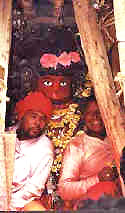
Red
Machchhendranath Festival
This festival takes place in Patan. During the
celebrations the towering chariot of Lord
Machchhendranath is pulled by ropes through the narrow
streets of the city followed by a large crowd of
worshippers. In front of the chariot, a small crowd of
musicians and soldiers add even more excitement to the
occasion. Over a period of several weeks, the chariot is
slowly hauled to Jawalakhel where tens of thousands of
devotees burn oil lamps and keep an all-night-vigil.
During this chariot festival the "Bhoto" or sacred
waistcoat, itself the subject of many legends is
displayed from the chariot as all the onlookers strain
to catch a glimpse of the lucky sight. A final ritual is
then conducted to mark Lord Machchhendranath's departure
for one year.
Buddha Jayanti (The Birthday of Lord Buddha)
Buddha Jayanti is a great day for the Nepalese. This day
which falls on the full moon of the month of Baisakh is
celebrated to commemorate the birth, attainment of
knowledge, and the death of Lord Buddha the founder
preacher of Buddhism, more than 2500 years ago. It is a
thrice-blessed day. It is the day when he attained
Nirvana (salvation). Prayers are sung and worship is
offered by the Buddhist in leading Buddhist shrines
throughout the country. At Swayambhunath temple for
example, devout Buddhists gather to chant prayers and
burn butter lamps. The next morning, a small shrines are
visited and worshipped. Parading groups walk through the
streets of Katmandu and Patan while special flags fly
from all Buddhist households.
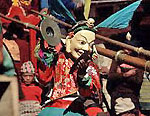
Mani
Rimdu
This typical Sherpa festival is celebrated exclusively
in the Lamaist monasteries of the Mt. Everest region. It
is held in the month of May, mostly on full moon day at
the Thame monastery in he Khumbu region, near Namche
Bazaar at an altitude of 13,123feet (4000m). A very
spectacular masked dance drama played for three full
days is the main outdoor highlight of the festival.
Back to Top
Sravan-(July-August)
Ghantakarna
Taking place towards the end of the Nepalese month of
Sravan, this festivals celebrates the exorcism of a
mythical demon, Ghantakarna, who, according to legend,
was greatly feared throughout the Katmandu Valley. The
festival is celebrated by acting out the legendary drama
in the streets. To begin with, children of each Katmandu
Neighborhood collect money from passersby which is then
used to make an effigy of the demon god. While this
effigy remains in the center of a rough tent-like
structure erected from bamboo poles, one man
impersonates Ghantakarna by smearing himself with white
paint and roaming the local area collecting donations in
a begging bowl. Surrounded by the crowds of small
children, the group then returns to the effigy and
proceeds to take it to the river for burning, thus
marking the victory of the local inhabitants over the
demon god.
Back to Top
Bhadra-(August-September)
Gai Jatra
According to tradition dating back since time
immemorial, every family who has lost one relative
during the past year must participate in a procession
through, the streets of Katmandu leading a cow. If a cow
is unavailable then a young boy dressed up as a cow is
considered to be a fair substitute. It is believed that
the symbol of a cow, revered as a holy animal by all
devout Hindus, will assist the deceased relative's
heavenward journey. Later in the Afternoon, nearly
everyone takes part in another age-old tradition in
which all participants dress up and wear masks; jokes,
mockery and humor of every kind become the order of the
day until the late evening.
Krishnaashtami
Krishnashtami or the birthday of Lord Krishna, is
celebrated in commemoration of the hero of the Hindu
epic, Mahabharata. On this day, worshippers carry ornate
and decorated idols and pictures of Lord Krishna through
the streets, often with bands of musicians following or
preceding the procession. In Patan, thousands of devout
flock to Krishna temple to worship and receive
blessings.
Indrajatra
The festival is celebrated by both the Hindus and
Buddhists with great enthusiasm. The festival continues
for eight days during which time there is much
rejoicing, dancing and feasting. On the first day, along
wooden pole is erected in front of the ancient Royal
Palace at Hunuman Dhoka, in order to propitiate Indra,
the god of rain. Classical dancers also assemble at the
spot wearing different kinds of masks and dancing around
the courtyard of Hanuman Dhoka to celebrate Indra's
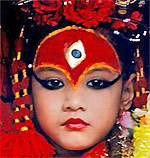
visit. On the third day of the festival, the Living
Goddess or "Kumari" is taken out in a procession in a
chariot. Three chariots of Kumari, Ganesh and Bhairav
are taken round the city for three days. The King also
pays homage to the Kumari during this time. The
festival's many other interesting dances including the
Mahakali, Mahalaxmi, and Dasha Avatara masked dances,
are staged on the plinth of Narayan temple, just
opposite the Kumari temple. On the last evening of the
festival, the long wooden pole erected on the first day
is lowered amid religious ceremonies and animal
sacrifices.
Back to Top
Ashwin-(September-October)
Dashain
Dashain is Nepal's most important and lavishly
celebrated festival. The first day of the festival is
known as Ghatasthapana-the placing of the sacred vessel.
According to the tradition, all devout Hindus should
take an early morning bath in the holy river and return
carrying some sand from the riverbed. At the same time,
a small clay pot is filled with water from the same
river and placed by the sand. Barely seeds are planted
in this pot and nurtured for nine days. As with other
Nepalese festivals, this ritual has also a specific
meaning. In this case, the river water represents the
mother goddess Durga, who according to legend, crushed
many powerful demon hordes in an epic battle. For the
next nine days, devouts, go to different prescribed
sites for early morning bathes.
The next major even occurs on the 7th day of the
festival when the sacred flowers and leaves are brought
from the old palace of Kind Prithvi Narayan Shah at
Gorkha. When the flowers reach Katmandu, there is a
large procession to Hanuman Dhoka gate where brass bands
are waiting to celebrate the occasion. At the same time,
guns and cannons are fired at Tundikhel parade ground.
The eighth day of the festival is known as Mahashtami
and is marked by a fast by all orthodox Hindus. In the
morning, animal sacrifices are carried out at temples
dedicated to Goddess Durga.
On the 9th day, all temples dedicated to Durga are
bathed in sacrificial blood. On this day, even vehicles
and other mechanical items are worshipped and sacrificed
so as to prevent accidents during the coming year.
Similarly, all instruments, weapons and implements of
all professions are worshipped in the hope that Durga
will bless their usefulness and accuracy. In the
evening, there is an elaborate sacrifice at the Taleju
temple near Hanuman Dhoka.
The peak of Dashain celebration is reached on the tenth
day known as Vijaya Dashami, or the Day of Victory. On
this day, all the Hindus are supposed to visit their
elders or superior relatives, starting with their
parents. The main purpose of this visit is to receive
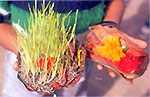
tika and shoots of the barley known as jamara. Tika is a
red dot or smear placed on the visitor's forehead by the
senior relative. Also frequently used in other festivals
and even in daily worship, the tika consists of
vermilion powder, rice and curd. As all visits cannot be
completed in one day, they continue until the end of the
festival.
Back to Top
Kartik-(October-November)
Tihar
After Dashain, Tihar is probably Nepal's second most
important festival. The first day of the festival is
crow's day. In the early morning, worshippers bathe
either in the Bagmati or some other river. After this
the devouts light a small lamp made of cotton wool and
mustard oil, and placed in a leaf pot. Then the first
portion of every family meal is offered to the crows.
The second day is known as the dog's day. On this
occasion dogs are given a red tika on their foreheads
and garlanded with flowers. They are then worshipped and
offered large plates of food, including many delicacies.
The next day is the cow's day and these animals are also
worshipped in the similar fashion. This day is even more
important day, as Laxmi Puja, or the day for worshipping
Laxmi the goddess of wealth also falls on this day.
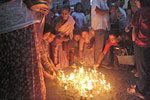
Towards the evening, small candles or wick lamps are
lighted and placed outside the main door and along
windowsills. This becomes a very beautiful spectacle as
the whole city, town and village become filled with
little lights.
The fourth day of Tihar is "self day" or "self worship."
As the name implies, this ritual aims to felicitate the
sprit dwelling in one's own body.
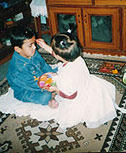
Brother's day or Bhai Tika is the fifth and last day of
Tihar. On this day, every sister worships her brothers
by placing a multicolored tika on their foreheads and
offering her blessings. The brothers then in turn give
tika to their sisters after which gifts are also
exchanged. As with many other festivals, Tihar ends with
a grand feast with all family members present.
Back to Top
Marg-(November-December)
Bala Chaturdashi
The festival of Bala Chaturdashi at Pashupatinath temple
celebrates an apocryphal legend of long ago. On the eve
of the festival, thousands of people from Katmandu and
its surroundings, proceed to Pashupatinath to keep an
all night vigil. Small wick lamps are lit after which
the worshippers spend the night chanting hymns and
dancing. At dawn, everyone makes their way to the holy
Bagmati river to bathe; acts of worship are then
performed at the temple's many shrines. The festival
concludes with all the worshippers scattering "sat biu,"
seven types of grain along a prescribed route starting
and ending at Pashupati temple. It takes several hours
to complete the task, after which worshippers begin
their journey home.
Sita Bibaha panchami
This festival, taking place in Janakpur in the eastern
Terai, celebrates the marriage of Rama and Sita, the
hero and heroine of the Hindu epic, Ramayana. During the
week before the festival starts, thousands of pilgrims
start to arrive in the city and a local fair is set up.
On the first day of the festival a large procession sets
out from Rama temple, carrying an image of Rama and
proceeding to the famous Janaki temple. The next day, in
an equally colorful ceremony, an idol of Sita is carried
to Rama's side thus re-enacting the ancient wedding of
the divine couple.
Back to Top
Paush-(December-January)
The Nepali month of Paush, although having less
festivals of a religious nature, features three
important birthday celebrations-those of the late King
Mahendra, the present King, His Majesty King Birendra
and the founder of Nepal as a nation, King Prithvi
Narayan Shah, The Great.
Constitution Day
The Birth anniversary of the Late King Mahendra On this
historic day, actually the first day of Paush,
processions all over the Kingdom celebrate the late King
Mahendra's birth anniversary. Various social and
cultural activities are also arranged to celebrate the
day when the Late king Mahendra announced the
establishment of Party less Panchayat Democracy in
Nepal, thus ushering in a new era of peace and
stability.
The
Birthday of His Majesty King Birendra
On the fourteenth day of Paush, birthday of His Majesty
King Birendra is celebrated not only throughout Nepal
but also by the Nepalese all over the world. Various
cultural and social programs take place to celebrate the
occasion.
The birth Anniversary of the Late King Prithvi Narayan
Shah, The Great
It was King Prithvi Narayan Shah who through careful
planning, foresight and ingenuity, transformed many
small and scattered kingdoms into one unified country.
His birth anniversary is celebrated as the Day of
National Unification throughout Nepal.
Back to Top
Fagun-(February-March)
National Democracy Day
The
Birth of Anniversary of the Late King Tribhuvan .This is
celebrated all over the Kingdom to observe the 7th of
Fagun 2007 BS(1951 AD) when the Nepalese people, led by
the Late King Tribhuvan, overthrew the autocratic Rana
regime. All government offices remain closed on this day
and parades, processions and other celebrations take
place throughout the country.
Shivaratri-The
night of Shiva
This festival, taking place at Pashupati temple on the
outskirts of Katmandu, is dedicated to the god Shiva. On
the morning of Shivaratri day and also on proceeding
days, thousands of worshippers make their way to the
ancient and revered temple of Shiva, many of them
undergoing one or more days of fasting. It is customary
to offer gifts both in the temple itself and to the
temple priests. The priests in turn, give back a small
portion which is considered a gift from Lord Shiva and a
sign of his blessing. While these religious rites
continue until the evening, there is along military gun
salute at Tundikhel parade ground in central Katmandu to
acknowledge the important occasion. In the evening, His
Majesty the King, accompanied by the Royal family, also
pays homage at Pashupati temple.
As darkness falls, hundreds of wick lamps are lit around
the temple vicinity while on the surrounding hills,
bonfires are lit. Throughout the night, prayers, singing
and chanting continue; many worshippers also take holy
baths at three-hourly intervals. Bonfires are also lit
at important crossroads and in village and town
courtyards throughout the valley.
Fagu
Fagu, also known as Holi, is a weeklong festival
celebrated all over Nepal. In Katmandu, it starts at
Hanuman Dhoka with the setting up of a "Chir" - a long
pole whose upper portion consists of wooden frames
decorated with strips of colorful cloth. These strips of
cloth are believed to carry special power to ward off
the evil. The following six days of festival are almost
normal; however, the last day is wildly celebrated with
people throwing colored powder and water at each other.
In every town of the country, there are jubilations in
the streets as the celebrants throw small balloons
filled either with ordinary or colored water. At the end
of the festival, the chir is taken down and burnt.
Back to Top
Chaitra-(March-April)
Ghode
Jatra
The festival of horses is a yearly sports event-taking
place at Tundikhel parade ground in central Katmandu.
Its roots go back several hundred years, though, it is
also associated with other older religious traditions.
For example, at midnight at the parade grou
nds, the images of Bhadra Kali and her sister goddess
are carried from their respective temples and placed in
the middle of the dark expanse. A third sister goddess
is then brought from another locality and made to bow
before the first two images. The actual horseracing is
conducted with great gusto and spectators come from all
over the valley, as well as from more distant parts, to
witness the exciting event.
Seto
Machchhendranath Jatra
Held annually, the main feature of this festival is a
weeklong chariot procession of Seto Machhendranath
Katmandu. A long chariot-decorated with flowers and
greenery, with the replica of the main deity, is taken
out in procession through the main throughfares of old
Katmandu.
Janai Poornima, Teej, Chaite
Dashain, Ram Nawami, Dumji and
Losar are other
important festivals of Nepal.
Back to Top
|
|